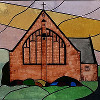
Mothering Sunday is a time to reflect on the reasons why there is a long-standing tradition of regarding the Church as a mother. Saint Cyprian, a north African bishop of the third century famously wrote that
"One cannot have God for one’s Father who does not have the Church for one’s Mother".
How we understand those words is, of course, shaped by our personal experiences of being fathered and mothered. Such language can be very difficult if those experiences were negative. Today’s readings help us towards a positive understanding of the nature of motherhood and of the ways in which the church can be a thought of as our mother.
Our reading from the first book of Samuel tells of Hannah, who had longed to be a mother, giving up her son once he was weaned and dedicating him to God. The Gospel includes Simeon’s words to Mary:
“and a sword will pierce your own soul too”
A reminder that the nourishing intimacy of motherly love will leave Mary open to the grief of watching her son tortured to death on a cross. A reminder of the broader point that to be in the relationships which give our lives meaning, value and purpose is to accept vulnerability, to accept that those whom we love are not our possessions and that loving may involve letting go. Indeed, good mothering and good fathering involves both providing a place where we will always be welcome yet also enabling and empowering us to leave it.
Today’s readings, especially the story of Hannah handing over the infant Samuel, remind me of the most unusual baptism at which I have ever assisted. The service was requested by a young mother who for reasons that were not shared with us was having to give up her recently born daughter into the care of social services. She had no way of knowing or shaping what would happen to her baby in the future or who would provide mothering for her. Her strongest wish was to ensure that her baby was baptised. That was the last thing she could do for her. I was then a curate and the parish priest who was my training incumbent, a wise and experienced man, agreed to baptise the baby even though it involved setting aside many of the rules about baptism. We had no way of knowing whether she would be raised in a Christian home, whether the promises made in the liturgy would be kept or whether the adoption process might take her to a different town and a different parish. The service took place in the watchful presence of a social worker, and we were told that once it was over, the baby would immediately be taken into care. A sword undoubtedly pierced that mother’s soul that day.
I hope that young mum took away some sense of the church as a family. She clearly had some understanding of the importance of baptism. Perhaps that included some understanding that the church is a place where we can enter into and be held in a family relationship with God. I hope that what she experienced that day was the church as a place of welcome and a love that was non-judgmental – the sort of love which Jesus showed to the Samaritan woman at the well, a love which, as Dean reflected in his sermon last Sunday, set aside the rules and reached across barriers of difference.
Today’s reading from St Paul’s letter to the Colossians offers instructions for the family life of the church.
“Clothe yourselves with compassion, kindness, humility, meekness, and patience.”
There’s a strong emphasis on forgiveness.
“Just as the Lord has forgiven you, so you also must forgive.”
These are qualities that are important in family life as the world understands it, as well as in the family life of the church. They are important to good fathering as well as to good mothering and both men and women are called to sustain the family life of the church, a family life centred on God.
Critics of Christianity often accuse us of having a patriarchal mindset. Yet you can find motherly imagery in the Bible. Remember Jesus’ lament over Jerusalem:
“How often have I desired to gather your children together as a hen gathers her brood under her wings, and you were not willing!”
You can also find motherly imagery in Christian writings from the Mediaeval period. Saint Anselm likened the suffering of Christ on the cross to the experience of a woman in labour.
“Jesus, by your dying we are born to new life,
By your anguish and labour we come forth in joy.”
And Julian of Norwich, the fourteenth century visionary whose Revelations of Divine Love is the earliest surviving book in English written by a woman, wrote these words:
“It is a characteristic of God to overcome evil with good. Jesus Christ, therefore, who himself overcame evil with good, is our true Mother. We received our ‘Being’ from Him and this is where His Maternity starts and with it comes the gentle Protection and Guard of Love which will never cease to surround us.”
“…the gentle Protection and Guard of Love which will never cease to surround us.”
That is the mothering we celebrate today.