'Advent Hope'
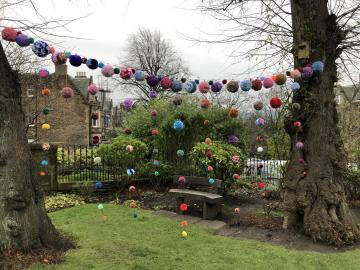
Our Winter yarn-bomb project! Thank you to everyone who made pom-poms during 'Lockdown'.
Scottish Episcopal Church, Murrayfield, Edinburgh
Our Winter yarn-bomb project! Thank you to everyone who made pom-poms during 'Lockdown'.
The illuminated advertising hoarding opposite Tesco Express on Roseburn Terrace isn’t often a stimulus to theological reflection, but a couple of the posters that are currently on electronic display there have a distinctly Advent feel to them. One of them has the strapline “Don’t get caught out” and the other reads “You need to act now”. They remind me of the urgency of John the Baptist’s call to his contemporaries to repent and his warning that they may not recognise the Messiah in their midst. In fact the purpose of the advertisements is to encourage businesses to prepare for the changes that will come on New Year’s Day when the Brexit transition period comes to an end. Business people have had a long and frustrating wait for clarity on those issues. Waiting and clarity are also Advent themes.
The Jews who journeyed to the Jordan valley to be baptized by John the Baptist, and those who came to question him were all waiting for the coming of the Messiah. The questioning to which John was subjected by the priests and the Levites suggests that some had begun to wonder whether John himself might be the Messiah. John’s behaviour was, after all, challenging and unusual. He was inviting people to be immersed in water and was linking that immersion with repentance.
Up to that point, water had been used by Jews for only two religious purposes: ritual purification and the ritual cleansing that converts to Judaism were required to undergo. John the Baptist was inviting people who were already Jews to go through that ritual of change, to acknowledge that they needed to change. For the repentance which John preached didn’t just (or even mainly) mean saying sorry for past wrong-doing – Jews have other rituals for that purpose. It meant turning round, changing your expectations of yourself and of others, rearranging your priorities. John was saying that observing the law and the prescribed rituals was not enough – religion is nothing unless it is life- changing. It’s easy to get caught out, John warns, and if you think that your religious practices are a destination, that you have in a spiritual sense arrived, then you aren’t waiting at all. You need to understand that you are on a journey. You need to act now and to act is to change.
Those who questioned John wanted clarity about his identity. Might he be Elijah? Or “the prophet” – and John rejected those suggestions. He answered their next question
“What do you say about yourself?”
in a way that was strikingly free from egotism, by quoting the prophet Isaiah:
“I am the voice of one crying out in the wilderness, ‘Make straight the way of the Lord’”
He shifted the focus away from himself and towards Jesus, and his next response is in the same vein:
“Among you stands one whom you do not know, the one who is coming after me: I am not worthy to untie the thong of his sandal.”
It’s both an answer that points towards Jesus, and an answer which hints that not everyone will be able to recognise Jesus as the Messiah. The Messiah is here, John says, but you do not know him and may not recognize him because you lack clarity of vision. Your expectations are wrong. If you are to recognize him, you will need to be open to change.
Advent invites us to reflect on the answer to the question “For whom are you waiting” and John the Baptist points us in the right direction. We are waiting for the light that came into the world when Jesus was born, the light that shines in the darkness. We know that in Advent we are waiting to celebrate once again the love of God made visible.
The eighteenth century French spiritual writer Jean Pierre de Caussade asked the question
“Why are we waiting?”
and answered it by suggesting that we need to act now:
As Dean reminded us in his sermon last week, we lose ourselves in the very heart of God by prayerful listening. Jean Pierre de Caussade taught that it is in the present moment that God is most present, present in our waiting and our listening. He put it thus:
“All that takes place within us, around us, or through us, contains and conceals God’s divine action.”
And it is in the waiting and the listening that we discover that.
Why are waiting? Because we know that God is present in Jesus in our human condition, and, because of that, is present in the here and now with all its difficulties and uncertainties, and present in the as yet unseen time that lies before us.
There seems to be an awful lot of shouting going on in today's readings but then perhaps shouting the message is better than mumbling as proposed by the Dean of the Cathedral of St.George, the Shires and the Utterly divided Trinity in one of his cathedral diaries (as found on the Tobymalcolm weblog):
"Is it time to revive the honourable custom of mumbling?At some theological colleges, ordinands are still taught in the best English tradition to mumble; to speak 'with the lips partly- closed' as the OED has it. For a church which needs to be everything and anything to the pewsman, it seems sermons delivered in a mumble are never misunderstood.
And what of 'mumble-matins?' Sadly, such are scarcely ever heard these days even by yonder combe or deepest dell. Rooker (does anyone read him nowadays?) tells how rising at 6am, he would stumble and mumble across the frost-rimed winter fields while saying the Offices in the falsetto tones, which so inspired a generation of vulgar artistes.
He would arrive at the last of his 19 parishes as two or three gathered, just in time for a flagon of porter and Devonshire porridge. Then as the sun dropped slowly in the western sky and the bells of Bovey Tracey rang out their evensong peal, the quiet and ancient tones of 'mumble-matins' would rise like wood smoke.
Writing at the time when our land was agog with dangerous enthusiasms, Rooker could not have anticipated that the Reformation would produce Albert the digital organist, or that doubtful enticement; 'The Antiques Road Show' (which comes to our Cathedral early in 2009 as a result of an over-enthusiastic Administrator). For Rooker, 'gums unarmed to mumble' as Dryden has it, made him a much misunderstood figure in our firmament. Would that today our Anglican communion could grow a generation of 'mumblers' who lead a blameless life from the pulpit without ever upsetting the faithful. "
Mumbling, would I agree not upset the faithful but today's readings remind us that we all need to be stirred up, now and again.
If like me you are a fan of historical novels you will be quite familiar with messengers arriving and
shouting out their news. Usually, in the novels the news they bring is more often than not, unpopular - well you wouldn't want to spoil a good story. In most cases the herald is exhausted having travelled far to proclaim their message. Sadly, some of them end up dead - either because others do not want the message to be delivered or the recipient doesn't like what he or she is told. Whatever their fate, messengers were important in conveying the news of the society in which they lived.
In our 21st century world it is all too easy to forget that radio and television or the internet have only been around in some form for the last 100 years or so and available to the masses for only a part of that time. Before we could listen or watch the news we depended on others bringing it to us, either in a printed or oral form. The messenger was vital in the life of society but there was an onus on them to get the message right and not to forget it, confuse it or deliberately change it.
John-the-Baptist is one such messenger and his ministry seems to have been foretold by the prophet Isaiah centuries before. In today’s readings what is clear is that the messenger is not the one 'to come' but merely the pre-cursor. The messenger, so says
Isaiah, is the one sent to tread the path 'to make a highway in the desert', to level out the uneven path for the more important figure to follow. Mark tells us that John-the-Baptist came to make 'the paths straight' and to encourage repentance. Both Mark and Isaiah seek to tell us that we need to prepare and be prepared to meet the Lord, the Christ.
But how are we to prepare?
In the lives we live today we need to prepare by creating time and space to listen to what-the prophets have to say. We have to try and clear space in our lives, hearts and minds in order to shut out the ungodly din of life and allow the godly voice of our Creator to talk to us. Easier said than done, though. So what to do?
This Advent try and find just a few minutes each day to be still, to stop and let the busyness of the world pass you by. You might snatch a few minutes as you wake up or go to sleep; as you stand waiting for a bus or as you drive somewhere without the radio on. However you grab this time, make trying to grab it a priority.
See this as prayer time in which: “The still, small voice of calm” can talk directly to you in the silence or even with just the silence.
We all need to hear the messages shouted by the prophets but we also need to hear the messages whispered or just 'felt' because it is often these messages that are meant for us. It is a bit scary, though, because if you are quiet and allow God to speak to you, you might find yourself having to do things you did not expect to do or particularly want to do. You might be challenged by the message to change.
Who are today's messengers or prophets?
This is difficult to answer but as God is God, then anyone you meet could be the messenger God is calling you to listen to. That's a sobering thought because it challenges us to keep on our toes, to keep awake. For if anyone we interact with could be God's messenger we need to be ever alert and ready to hear and respond to the message given. We are called to be like watchmen, ever awake, ever ready to espy the herald as he or she approaches and then to be prepared to respond to what we are told.
So as well as trying to carve out space and quiet this Advent, you've also got to be ready to respond
to what you might hear and who knows what message you or I might be given before the 25th December, as we continue to journey through this anticipation time of Advent.
We are at the beginning of a new year; the Church’s calendar refreshes itself today and we begin anew at Advent Sunday. The Church year starts a month or so before the calendar year so for most people 2020 is not yet over. For many this year, I suspect the ending of 2020 will come with very mixed emotions. It has been a very strange (and forgive the too often repeated word) ‘unprecedented’ eleven months, thus far. 2020 will no doubt go down in history as a year when things changed, when normal disappeared and all the familiar map reference points of our lives were swept away and new ones put in their place. With all this in mind, these words from Stephen Cherry’s poem ‘Advent wreath’ feel very apt to me:
I wonder about circles
and straight lines.
I wonder about eternity
and time.
I wonder, though this sounds grand, about the
purpose of my life.
Wondering and pondering on what one’s life means is something I have found myself doing a great deal this year as what I thought was familiar and stable has proved not to be. I have had to re-establish where my life’s ‘map-reference’ points are; some of them have remained the same, like praying Morning Prayer before breakfast but others have changed dramatically, not least worship on Sundays and Wednesdays. Friends I used to see regularly cannot now be visited, but thank goodness for the telephone and Zoom. Twelve months ago who had heard of Zoom? I certainly hadn’t and getting to grips with it was only one of the computer things I had to rapidly teach myself. For many of you that will sound familiar. So pondering on the circles of life or its straight lines will probably resonate.
Advent is always a time for reflection as we anticipate the coming birthday celebrations of our Lord. The readings take on an apocalyptic theme looking to the end time and the coming again of the Christ and we do it through the lens of the first coming of Christ some 2000 years ago. I often wonder if the second coming will be like the first. Unexpected and surprising, almost unnoticed yet world changing. Will Christ’s coming turn the world upside down or will he be ignored? If a minute virus can change the world, I hope that the returning Christ will do the same.
Advent also reminds us that we do not know when Christ will return, just as our ancestors did not know when the Messiah would come. We can look for signs in the heavens or attribute natural disasters as sign posts to Christ’s return or we can just pray, that one day Christ will come again and that our lives will be transformed by his power and grace and above all, by his all embracing love. Christ’s first coming came from an act of love and I would think that God would probably do the same again. Because, above all else our God is a God of love. A God who loves us so much that he sent his Son to redeem us and to show us the error of our previous ways and in whose birth, death and resurrection we are still intimately bound up. Whether or not we accept Christ as our Saviour we cannot ignore the fact that we are united with him in all that he has done. Christ did not come to us the first time only for selected individuals he came for everyone regardless of who they were and whether or not they were able to acknowledge who he was. This remains as true today as it was then.
Today we will light the first candle - of light in the darkness - on the Advent wreath as I hope you will do so at home as well. A candle signifying the start of our journey through Advent with Christ, as we hear and respond to the call of the Old Testament prophets who hoped for the Messiah to redeem them. As we light the candle ‘wonder’ at what it signifies and how it relates to your life; ponder on the meaning of life and whether time is linear or circular. What does time mean in your life and where does Christ fit into it as well? How are you journeying through the years and what does this past year tell us about that journey? A challenge for all of us as we pilgrimage through Advent. Amen.
Christ The King – Sunday 22nd November 2020
I wonder what you have on your bedside table? Is there a telephone; a glass of water or a pen and notepad? Perhaps also a photograph of someone special or a small gift given by a family member or dear friend? For me, I have an icon of “Jesus Christ Pantocrater”. It is based upon the mosaic which I first saw years ago when I visited the magnificent former Church of Hagia Sophia in Istanbul built around 537.
Many of you will be familiar with it. Some of you may also have other icons, pictures or devotional aids which are important. This one depicts Christ in his majesty. In his left hand he holds the New Testament. In his right hand he makes the sign of a blessing. The word “Pantocrator” is often interpreted as “strength, might and power” or the one I particularly like “sustainer of the world”. Not surprisingly, the Eastern Orthodox Church and the Western (Roman) Church place different emphasis on this too.
For me, this icon gives an insight into the character of God. In the foreword to Rowan Williams’ book “Ponder these things”, Kallistos Ware, Bishop of Diokleia, writes “ An icon introduces us to a world of mystery, yet at the same time this mystery is not far away, but is hidden within each of us, closer to us than our own heart”. Rowan Williams himself writes that “Icons show us the way; they invite us to follow a journey, to engage in a pilgrimage. They help us to cross borders, to enter into a new and transfigured world”.
One of the books which I have enjoyed reading is by Richard Harries, the former Bishop of Oxford. It is entitled “Seeing God in Art – the Christian Faith in thirty images”. The penultimate painting is entitled “Christ Glorified in the Court of Heaven” by Fra Angelico painted between 1423-24. He comments that it “conveys a wonderful sense of joy, ecstasy, music, movement and dance all focused and drawn out by the figure of Christ in the middle”. Do look at it if you can. He asks “Is life heading anywhere? Is there some great consummation ahead? Is there some climax beyond space and time?” These are hard and deep questions which we all face at different times.
The Feast of Christ the King completes the liturgical year in the Christian calendar. Next Sunday we start all over again with the beginning of Advent and so it continues afresh year by year. As someone who prefers negotiation and resolution I find this comforting and re-assuring. What is more challenging is when things remain incomplete or unresolved for whatever reason.
Looking back this past liturgical year, we all have our own stories to tell. Some will be filled with joy and thankfulness. Others will be filled with sadness, dis-appointment, bewilderment and those nagging questions which never quite go away. The effect of the coronavirus still continues to impact upon our lives and globally.
In our reading from Ephesians (1:15-23) we are offered some encouragement by the apostle Paul as we journey together in faith, in love, in hope. He prays that we might all be given a spirit of wisdom and revelation as we come to know him (Jesus) so that, with the eyes of our heart enlightened, we might know something of the hope to which we have been called.
May we continue to hope in Christ the King as we journey together in our life of faith.